
fire extinguisher cabinet FAQ
The Fire extinguisher cabinet Frequently Asked Questions (FAQ) page has been designed to address the most common questions raised by users, employers, and safety specialists regarding fire extinguisher cabinets. On this page, we have aimed to provide accurate, clear, and practical information in order to answer all concerns and ambiguities related to the selection, installation, maintenance, and proper use of fire extinguisher cabinets.
Importance of Studying the Fire extinguisher cabinet FAQ :
The importance of reviewing the Fire extinguisher cabinet Frequently Asked Questions lies in the fact that many individuals, during the purchase or use of this equipment, encounter points and details whose awareness can prevent costly financial mistakes and irreversible human losses. This document serves as a comprehensive reference source, helping you make informed decisions with full awareness.
In various sections of the Fire extinguisher cabinet FAQ, topics such as the differences between recessed and surface-mounted cabinets, the concept of standards, correct installation methods, appropriate spacing between cabinets, and technical details related to the hose and reel are addressed. In addition, if you have any questions regarding the cabinet body materials or the types of equipment installed inside the cabinet, you will find the answers in this document.
One of the main advantages of the Fire extinguisher cabinet FAQ page is that its information has been prepared in a fully up-to-date manner and in accordance with the regulations of the Fire Department. Therefore, you can use this content with complete confidence for the proper selection and use of fire extinguisher cabinets.
In designing the Fire extinguisher cabinet FAQ page, the content has been developed to be understandable for the general public while remaining practical and precise for safety specialists. This approach has turned this page into one of the most visited and reliable educational resources in the field of fire extinguisher cabinets.
If you are currently reviewing different options for purchasing or installing fire extinguisher cabinets, we recommend that you first read the Fire extinguisher cabinet FAQ page. This will not only increase your level of knowledge but will also prevent common errors in the selection and use of equipment.
Ultimately, the main goal of preparing the Fire extinguisher cabinet FAQ page is to enhance safety levels, increase public awareness, and assist in the correct selection of fire suppression equipment. We hope this content proves useful to you and is able to answer all your questions regarding fire extinguisher cabinets.
fire extinguisher cabinet FAQs
A surface-mounted fire extinguisher cabinet is installed on the wall and remains visible, while a recessed fire hose cabinet is embedded within the wall, providing a cleaner and more organized appearance. It should be noted that at Ader Tavan Nami, customization options such as concealed locks, hidden hardware, and other design features are available.
No, fire extinguisher cabinets are also installed in factories, warehouses, shopping centers, hospitals, and even in urban public spaces.
A fire extinguisher cabinet usually contains a fire hose, hose reel, nozzle, shut-off valve, couplings, and in some cases, a fire extinguisher and a fire blanket.
Fire extinguisher cabinets are highly effective for initial fire suppression; however, for large-scale fires, complementary firefighting systems must be used.
Yes, fire extinguisher cabinets must be identified with clear warning signs to ensure rapid recognition during emergencies. They are typically marked with the letter “F” and the color red.
Yes, emergency exit stairwells, landings, and entrances are among the most suitable locations for installing ( fire extinguisher cabinets ) fire hose cabinets.
Yes, fire extinguisher cabinets designed with corrosion-resistant bodies and moisture-resistant materials are suitable for outdoor environments.
Yes, fire extinguisher cabinets must be manufactured and approved in accordance with national and international standards.
NFPA, EN, ISIRI, and CE standards are among the most recognized and valid standards for fire extinguisher cabinets.
Yes, periodic testing of water pressure and operational performance is required. Additionally, cabinet doors must be tested to ensure easy and rapid access to the equipment.
Fire extinguisher cabinets should be inspected at least every six months, and a comprehensive annual inspection and testing of both the cabinet and its internal equipment must be conducted.
Fire extinguisher cabinets made of stainless steel or coated with electrostatic paint are resistant to corrosion and rust.
Yes, fire extinguisher cabinets are designed with steel or stainless steel bodies to withstand impact and pressure. The sheet thickness plays a critical role in resistance against impact and other external factors.
Yes, fire extinguisher cabinets are typically equipped with quick-release or concealed locks to allow fast access during emergencies while preventing tampering by unauthorized individuals or children. Currently, fire authorities recommend the use of breakable (emergency-type) door locks for fire hose cabinets.
No, fire extinguisher cabinets are installed at appropriate heights and are generally equipped with locks to prevent misuse.
Yes, fire extinguisher cabinets must be installed in clearly visible and easily accessible locations.
Yes, fire extinguisher cabinets with special protective standards are also used in military projects.
The price of a fire extinguisher cabinet depends on factors such as material, dimensions, cabinet type, sheet thickness, internal equipment, and brand. Since pricing is influenced by current material costs, for accurate pricing and free project consultation, please contact our experts directly.
To purchase reliable fire extinguisher cabinets, it is recommended to buy from specialized manufacturers, safety equipment suppliers, or authorized distributors.
Yes, purchasing from reputable websites that provide trust certification and complete technical specifications ensures secure delivery with warranty.
Body material, installation type (recessed or surface-mounted), internal equipment, brand, applicable standards, and sheet thickness all influence the final price.
Due to the critical importance of safety and the protection of life and property, the use of used fire extinguisher cabinets is not recommended unless they have been thoroughly inspected, tested, and certified.
Yes, Ader Tavan Nami offers special discounts for bulk purchases of fire extinguisher cabinets for construction, industrial, and urban projects.
Ader Tavan Nami fire extinguisher cabinets are covered by a one-year warranty with a verifiable code available on the company’s official website, along with 10 years of after-sales service.
Some suppliers and manufacturers offer installment payment options for large-scale projects.
Yes, many Iranian manufacturers produce high-quality fire extinguisher cabinets in compliance with international standards. As a leading custom manufacturer of firefighting equipment, Ader Tavan Nami has exported its products to numerous countries, particularly due to its unique custom luxury and premium fire hose cabinets.
In some cases, foreign cabinets may be more well-known in terms of branding or design; however, Iranian fire extinguisher cabinets are highly competitive in terms of quality, services, and customization capabilities.
Fire extinguisher cabinets should be installed by certified safety technicians or approved contractors to ensure proper placement and correct connections
In some projects, installation must be approved by the fire department or the supervising engineer.
Yes, fire extinguisher cabinets must be connected to the firefighting water network or a central pump system to ensure adequate pressure.
If the fire extinguisher cabinet body is damaged, internal equipment is defective, or standards have been updated, replacement is required.
Fire extinguisher cabinets are coated with electrostatic paint; however, if damaged or corroded, they can be repainted.
Yes, in large projects, numbering fire extinguisher cabinets is essential for management, servicing, and auditing purposes.
Yes, the exact location of fire extinguisher cabinets must be shown on the building’s safety and evacuation plans.
Fire extinguisher cabinets are typically fixed installations; however, in some projects, portable or wheeled models are also used.
Yes, hoses and fittings inside fire extinguisher cabinets must undergo periodic pressure testing.
In outdoor installations, fire extinguisher cabinets should be protected with UV-resistant coatings or shading to prevent discoloration and damage.
Yes, in accordance with national building regulations and fire department requirements, the installation of fire extinguisher cabinets is mandatory in public, commercial, and residential buildings.
Yes, obtaining fire department approval for the installation of fire extinguisher cabinets is required in order to receive the building completion certificate.
Yes, at Ader Tavan Nami, fire extinguisher cabinets can be fully customized in terms of color, logo, and exclusive design for brands and projects, in accordance with the client’s specifications.
Yes, fire extinguisher cabinets designed for hotels are offered with an elegant appearance, glass doors, and complete equipment.
Yes, fire extinguisher cabinets in hospitals must be installed with hygienic equipment, soft-opening doors, and specific placement requirements. Since hospital equipment must be regularly disinfected and kept clean, stainless steel materials are typically used for these cabinets.
Yes, industrial fire extinguisher cabinets are designed with thicker bodies, lockable doors, and professional-grade equipment.
Yes, fire extinguisher cabinets in commercial centers are designed to match the interior décor and are often equipped with glass doors. At Ader Tavan Nami, logo printing, laser engraving, and other customization options are also available. (In this regard, we recommend reviewing the Luxury Fire Extinguisher Cabinet product.)
No, fire extinguisher cabinets must not be installed inside elevators; however, installation on landings or adjacent to elevator entrances is permitted.
Yes, fire extinguisher cabinets are installed in parking facilities to address vehicle-related fire hazards.
Yes, in luxury projects, fire extinguisher cabinets are offered with minimalistic designs, custom colors, or finishes that match the stone or architectural facade used in the project, along with complete firefighting equipment. (In this regard, we recommend reviewing the Luxury Fire Extinguisher Cabinet product.)
Yes, companies such as Ador Tavan Nami provide custom design and manufacturing services. Customization at Ader Tavan Nami is carried out with the highest level of detail, including materials, color, dimensions, logo printing, and more.
Luxury fire extinguisher cabinet offer superior appearance design, body materials (such as stainless steel or electrostatic powder coating), lock and hardware types, and internal equipment quality. They are used in special or luxury building projects. Standard cabinets are mainly designed for industrial or general applications. At Ader Tavan Nami, it is also possible to customize cabinets in accordance with the building façade.
Yes, luxury fire extinguisher cabinets, stainless steel nozzles, and concealed fire alarm systems have been installed in high-end residential and commercial projects. You may review the Luxury Fire Cabinet product in the Fire Cabinet and Products section of the website.
A fire extinguisher cabinet is a small, fixed unit designed for initial fire suppression and is essential in buildings, hospitals, and similar facilities, whereas a fire station is an operational center equipped with comprehensive resources and trained personnel.
Standards and Safety FAQs
Fire extinguisher cabinets should be inspected at least every six months, and a comprehensive annual inspection and testing of both the cabinet and its internal equipment must be conducted.
Fire extinguisher cabinets made of stainless steel or coated with electrostatic paint are resistant to corrosion and rust.
Yes, fire extinguisher cabinets are designed with steel or stainless steel bodies to withstand impact and pressure. The sheet thickness plays a critical role in resistance against impact and other external factors.
Yes, fire extinguisher cabinets are typically equipped with quick-release or concealed locks to allow fast access during emergencies while preventing tampering by unauthorized individuals or children. Currently, fire authorities recommend the use of breakable (emergency-type) door locks for fire hose cabinets.
No, fire extinguisher cabinets are installed at appropriate heights and are generally equipped with locks to prevent misuse.
Yes, fire extinguisher cabinets must be installed in clearly visible and easily accessible locations.
Yes, fire extinguisher cabinets with special protective standards are also used in military projects.
Ader Tavan Nami fire extinguisher cabinets are covered by a one-year warranty with a verifiable code available on the company’s official website, along with 10 years of after-sales service.
Yes, many Iranian manufacturers produce high-quality fire extinguisher cabinets in compliance with international standards. As a leading custom manufacturer of firefighting equipment, Ader Tavan Nami has exported its products to numerous countries, particularly due to its unique custom luxury and premium fire hose cabinets.
Yes, small fire extinguishers designed for vehicles, smoke alarm systems, and emergency equipment can be installed.
Yes, due to the sensitivity of medical equipment and the presence of patients, equipment must comply with specific hospital-grade standards.
Yes, since Ador Tavan Nami is a registered vendor on oil and gas refinery vendor lists, our products are certified by the national Fire Department organizations and comply with national and international standards such as ISIRI and NFPA.
Yes, specialized equipment such as fire monitors, foam chambers, foam tanks, and industrial valves are designed and manufactured for oil, gas, and petrochemical projects. Additionally, foam tanks, which are among the main equipment for such projects, are custom-manufactured based on the client’s technical requirements. Product test and inspection videos are available in the video and image gallery section of the website.
Many of the products are designed and manufactured in compliance with NFPA standards. These standards include requirements for the design, installation, and operational performance of safety equipment.
Yes, many products are equipped with QR code labels that allow users to access technical information, warranty details, and user manuals by scanning. In addition, all products have downloadable PDF drawings available in the products section of the website.
Yes, equipment such as fire monitors, nozzles, and metal cabinets are manufactured using materials resistant to high temperatures.
Yes, the company’s products have been used in training and operational drills by fire department organizations, and their performance has been verified. Moreover, many prominent firefighters across the country have tested and evaluated Ader Tavan Nami products and expressed positive feedback, even in comparison with well-known global brands.
Yes, after-sales services including technical support, repairs, spare parts supply, and specialized consulting are provided. All Ader Tavan Nami products are covered by a 10-year after-sales service.
This includes fire detection and fire suppression systems, fire monitors, foam chambers, foam tanks, industrial fire cabinets, emergency showers, safety eyewash stations, and personal protective equipment (PPE).
In some cases, yes. However, it is strongly recommended that installation be carried out by trained technicians to ensure compliance with safety standards and to maintain the product warranty.
Periodic inspection of system and equipment performance, checking extinguisher pressure, ensuring the integrity of components, cleaning, and documenting service reports are mandatory.
Yes, specialized equipment compliant with ATEX standards is designed for hazardous and explosive environments. Ader Tavan Nami is proud to be the first and sole domestic manufacturer in Iran to produce certain specialized firefighting equipment that was previously available only from foreign suppliers. One such example is the foam system integrated with a foam tank, images of which can be viewed in the product gallery.
Yes, some products feature a high IP protection rating and are suitable for dusty industrial environments. Furthermore, upon client instruction and for harsh operating conditions, the use of more durable materials tailored to the project environment is possible.
Frequently asked questions about installation, repair and maintenance of fire equipments
In some projects, installation must be approved by the fire department or the supervising engineer.
Yes, fire extinguisher cabinets must be connected to the firefighting water network or a central pump system to ensure adequate pressure.
If the fire extinguisher cabinet body is damaged, internal equipment is defective, or standards have been updated, replacement is required.
Fire extinguisher cabinets are coated with electrostatic paint; however, if damaged or corroded, they can be repainted.
Yes, in large projects, numbering fire extinguisher cabinets is essential for management, servicing, and auditing purposes.
Yes, the exact location of fire extinguisher cabinets must be shown on the building’s safety and evacuation plans.
Fire extinguisher cabinets are typically fixed installations; however, in some projects, portable or wheeled models are also used.
Yes, hoses and fittings inside fire extinguisher cabinets must undergo periodic pressure testing.
In outdoor installations, fire extinguisher cabinets should be protected with UV-resistant coatings or shading to prevent discoloration and damage.
Yes, in accordance with national building regulations and fire department requirements, the installation of fire extinguisher cabinets is mandatory in public, commercial, and residential buildings.
Yes, they typically have a service life of 5 to 10 years and must be periodically inspected and recharged. Annual testing is essential to ensure proper performance during emergencies.
They should be installed upright, in a dry place, away from direct sunlight, at a suitable and accessible height. Pressure checks and inspection of the body condition are also necessary.
Yes, many fire extinguishers are rechargeable, and this process must be carried out by authorized service centers.
Yes, all products manufactured by this company are covered by a one-year official warranty with a verifiable code on the company’s official website. By entering the warranty code registered on the product in the website section, online verification is available.
Yes, the company’s technical team provides installation, commissioning, and on-site training services for equipment use. These services include performance testing and issuance of confirmation certificates. In high-volume projects, clients can also visit the factory production line and observe the manufacturing process upon prior request.
Yes, after-sales services including technical support, repairs, spare parts supply, and specialized consulting are provided. All Ader Tavan Nami products are covered by a 10-year after-sales service.
In some cases, yes. However, it is strongly recommended that installation be carried out by trained technicians to ensure compliance with safety standards and to maintain the product warranty.
Periodic inspection of system and equipment performance, checking extinguisher pressure, ensuring the integrity of components, cleaning, and documenting service reports are mandatory.
Yes, upon client request, many products can be integrated with Building Management Systems (BMS) and smart home platforms.
Yes, specialized equipment compliant with ATEX standards is designed for hazardous and explosive environments. Ader Tavan Nami is proud to be the first and sole domestic manufacturer in Iran to produce certain specialized firefighting equipment that was previously available only from foreign suppliers. One such example is the foam system integrated with a foam tank, images of which can be viewed in the product gallery.
Yes, the professional and experienced engineering team at Ader Tavan Nami can design execution drawings, including piping routes, equipment installation locations, and alarm points.
Yes, luxury fire extinguisher cabinets, stainless steel nozzles, and concealed fire alarm systems have been installed in high-end residential and commercial projects. You may review the Luxury Fire Cabinet product in the Fire Cabinet and Products section of the website.
Yes, smoke, heat, and gas detection systems can be integrated and synchronized with fire suppression equipment.
Yes, equipment resistant to heat, explosion, and corrosion has been installed in refineries and petrochemical complexes. Phase 14 of South Pars is one of Ader Tavan Nami’s petrochemical projects, where the fire detection and suppression system was designed and implemented by the company.
In data centers, fire extinguisher cabinets must be integrated with non-conductive equipment and gas-based fire suppression systems.
Frequently Asked Questions about Fire Equipment Costs and Prices
The price of a fire extinguisher cabinet depends on factors such as material, dimensions, cabinet type, sheet thickness, internal equipment, and brand. Since pricing is influenced by current material costs, for accurate pricing and free project consultation, please contact our experts directly.
To purchase reliable fire extinguisher cabinets, it is recommended to buy from specialized manufacturers, safety equipment suppliers, or authorized distributors.
Yes, purchasing from reputable websites that provide trust certification and complete technical specifications ensures secure delivery with warranty.
Body material, installation type (recessed or surface-mounted), internal equipment, brand, applicable standards, and sheet thickness all influence the final price.
Due to the critical importance of safety and the protection of life and property, the use of used fire extinguisher cabinets is not recommended unless they have been thoroughly inspected, tested, and certified.
Yes, Ader Tavan Nami offers special discounts for bulk purchases of fire extinguisher cabinets for construction, industrial, and urban projects.
Some suppliers and manufacturers offer installment payment options for large-scale projects.
Fire extinguisher cabinets should be installed by certified safety technicians or approved contractors to ensure proper placement and correct connections
Frequently Asked Questions Legal Requirements for Fire Fighting Equipment
Yes, in accordance with national building regulations and fire department requirements, the installation of fire extinguisher cabinets is mandatory in public, commercial, and residential buildings.
Yes, obtaining fire department approval for the installation of fire extinguisher cabinets is required in order to receive the building completion certificate.
Yes, at Ader Tavan Nami, fire extinguisher cabinets can be fully customized in terms of color, logo, and exclusive design for brands and projects, in accordance with the client’s specifications.
Yes, fire extinguisher cabinets designed for hotels are offered with an elegant appearance, glass doors, and complete equipment.
Yes, fire extinguisher cabinets in hospitals must be installed with hygienic equipment, soft-opening doors, and specific placement requirements. Since hospital equipment must be regularly disinfected and kept clean, stainless steel materials are typically used for these cabinets.
Yes, industrial fire extinguisher cabinets are designed with thicker bodies, lockable doors, and professional-grade equipment.
Yes, fire extinguisher cabinets in commercial centers are designed to match the interior décor and are often equipped with glass doors. At Ader Tavan Nami, logo printing, laser engraving, and other customization options are also available. (In this regard, we recommend reviewing the Luxury Fire Extinguisher Cabinet product.)
No, fire extinguisher cabinets must not be installed inside elevators; however, installation on landings or adjacent to elevator entrances is permitted.
Yes, fire extinguisher cabinets are installed in parking facilities to address vehicle-related fire hazards.
Yes, in luxury projects, fire extinguisher cabinets are offered with minimalistic designs, custom colors, or finishes that match the stone or architectural facade used in the project, along with complete firefighting equipment. (In this regard, we recommend reviewing the Luxury Fire Extinguisher Cabinet product.)
Yes, according to occupational health and safety regulations, the use of safety equipment in industrial environments is mandatory.
Yes, according to educational regulations, schools must be equipped with fire detection and fire suppression systems.
This includes fire detection and fire suppression systems, fire monitors, foam chambers, foam tanks, industrial fire cabinets, emergency showers, safety eyewash stations, and personal protective equipment (PPE).
All frequently asked questions about fire extinguishers and fire equipment
A surface-mounted fire extinguisher cabinet is installed on the wall and remains visible, while a recessed fire hose cabinet is embedded within the wall, providing a cleaner and more organized appearance. It should be noted that at Ader Tavan Nami, customization options such as concealed locks, hidden hardware, and other design features are available.
No, fire extinguisher cabinets are also installed in factories, warehouses, shopping centers, hospitals, and even in urban public spaces.
A fire extinguisher cabinet usually contains a fire hose, hose reel, nozzle, shut-off valve, couplings, and in some cases, a fire extinguisher and a fire blanket.
Fire extinguisher cabinets are highly effective for initial fire suppression; however, for large-scale fires, complementary firefighting systems must be used.
Yes, fire extinguisher cabinets must be identified with clear warning signs to ensure rapid recognition during emergencies. They are typically marked with the letter “F” and the color red.
Yes, emergency exit stairwells, landings, and entrances are among the most suitable locations for installing ( fire extinguisher cabinets ) fire hose cabinets.
Yes, fire extinguisher cabinets designed with corrosion-resistant bodies and moisture-resistant materials are suitable for outdoor environments.
Yes, fire extinguisher cabinets must be manufactured and approved in accordance with national and international standards.
NFPA, EN, ISIRI, and CE standards are among the most recognized and valid standards for fire extinguisher cabinets.
Yes, periodic testing of water pressure and operational performance is required. Additionally, cabinet doors must be tested to ensure easy and rapid access to the equipment.
Fire extinguisher cabinets should be inspected at least every six months, and a comprehensive annual inspection and testing of both the cabinet and its internal equipment must be conducted.
Fire extinguisher cabinets made of stainless steel or coated with electrostatic paint are resistant to corrosion and rust.
Yes, fire extinguisher cabinets are designed with steel or stainless steel bodies to withstand impact and pressure. The sheet thickness plays a critical role in resistance against impact and other external factors.
Yes, fire extinguisher cabinets are typically equipped with quick-release or concealed locks to allow fast access during emergencies while preventing tampering by unauthorized individuals or children. Currently, fire authorities recommend the use of breakable (emergency-type) door locks for fire hose cabinets.
No, fire extinguisher cabinets are installed at appropriate heights and are generally equipped with locks to prevent misuse.
Yes, fire extinguisher cabinets must be installed in clearly visible and easily accessible locations.
Yes, fire extinguisher cabinets with special protective standards are also used in military projects.
The price of a fire extinguisher cabinet depends on factors such as material, dimensions, cabinet type, sheet thickness, internal equipment, and brand. Since pricing is influenced by current material costs, for accurate pricing and free project consultation, please contact our experts directly.
To purchase reliable fire extinguisher cabinets, it is recommended to buy from specialized manufacturers, safety equipment suppliers, or authorized distributors.
Yes, purchasing from reputable websites that provide trust certification and complete technical specifications ensures secure delivery with warranty.
Body material, installation type (recessed or surface-mounted), internal equipment, brand, applicable standards, and sheet thickness all influence the final price.
Due to the critical importance of safety and the protection of life and property, the use of used fire extinguisher cabinets is not recommended unless they have been thoroughly inspected, tested, and certified.
Yes, Ader Tavan Nami offers special discounts for bulk purchases of fire extinguisher cabinets for construction, industrial, and urban projects.
Ader Tavan Nami fire extinguisher cabinets are covered by a one-year warranty with a verifiable code available on the company’s official website, along with 10 years of after-sales service.
Some suppliers and manufacturers offer installment payment options for large-scale projects.
Yes, many Iranian manufacturers produce high-quality fire extinguisher cabinets in compliance with international standards. As a leading custom manufacturer of firefighting equipment, Ader Tavan Nami has exported its products to numerous countries, particularly due to its unique custom luxury and premium fire hose cabinets.
In some cases, foreign cabinets may be more well-known in terms of branding or design; however, Iranian fire extinguisher cabinets are highly competitive in terms of quality, services, and customization capabilities.
Fire extinguisher cabinets should be installed by certified safety technicians or approved contractors to ensure proper placement and correct connections
In some projects, installation must be approved by the fire department or the supervising engineer.
Yes, fire extinguisher cabinets must be connected to the firefighting water network or a central pump system to ensure adequate pressure.
If the fire extinguisher cabinet body is damaged, internal equipment is defective, or standards have been updated, replacement is required.
Fire extinguisher cabinets are coated with electrostatic paint; however, if damaged or corroded, they can be repainted.
Yes, in large projects, numbering fire extinguisher cabinets is essential for management, servicing, and auditing purposes.
Yes, the exact location of fire extinguisher cabinets must be shown on the building’s safety and evacuation plans.
Fire extinguisher cabinets are typically fixed installations; however, in some projects, portable or wheeled models are also used.
Yes, hoses and fittings inside fire extinguisher cabinets must undergo periodic pressure testing.
In outdoor installations, fire extinguisher cabinets should be protected with UV-resistant coatings or shading to prevent discoloration and damage.
Yes, in accordance with national building regulations and fire department requirements, the installation of fire extinguisher cabinets is mandatory in public, commercial, and residential buildings.
Yes, obtaining fire department approval for the installation of fire extinguisher cabinets is required in order to receive the building completion certificate.
Yes, at Ader Tavan Nami, fire extinguisher cabinets can be fully customized in terms of color, logo, and exclusive design for brands and projects, in accordance with the client’s specifications.
Yes, fire extinguisher cabinets designed for hotels are offered with an elegant appearance, glass doors, and complete equipment.
Yes, fire extinguisher cabinets in hospitals must be installed with hygienic equipment, soft-opening doors, and specific placement requirements. Since hospital equipment must be regularly disinfected and kept clean, stainless steel materials are typically used for these cabinets.
Yes, industrial fire extinguisher cabinets are designed with thicker bodies, lockable doors, and professional-grade equipment.
Yes, fire extinguisher cabinets in commercial centers are designed to match the interior décor and are often equipped with glass doors. At Ader Tavan Nami, logo printing, laser engraving, and other customization options are also available. (In this regard, we recommend reviewing the Luxury Fire Extinguisher Cabinet product.)
No, fire extinguisher cabinets must not be installed inside elevators; however, installation on landings or adjacent to elevator entrances is permitted.
Yes, fire extinguisher cabinets are installed in parking facilities to address vehicle-related fire hazards.
Yes, in luxury projects, fire extinguisher cabinets are offered with minimalistic designs, custom colors, or finishes that match the stone or architectural facade used in the project, along with complete firefighting equipment. (In this regard, we recommend reviewing the Luxury Fire Extinguisher Cabinet product.)
Fire detection is responsible for identifying and warning about a fire, while fire suppression includes the equipment and processes used to control or extinguish a fire.
A CO₂ fire extinguisher is the best option because it is non-conductive and does not damage electrical equipment.
It is a set of international standards for the design, installation, and maintenance of safety and firefighting equipment, developed by the National Fire Protection Association (USA).
Yes, periodic servicing is mandatory to ensure safe and proper operation of the equipment. At Ader Tavan Nami, all products are covered by a 10-year after-sales service to ensure optimal performance during emergencies and to provide complete peace of mind for employers.
Dry powder extinguishers are suitable for Class A, B, and C fires, while water fire extinguishers are only applicable to Class A fires involving solid combustible materials.
Yes, especially in multi-story buildings or enclosed spaces, sprinklers play a critical role in fire control.
Firefighting foam creates a layer over the fuel surface, preventing oxygen from reaching the fire and thereby smothering it (removing oxygen from the fire triangle).
A fire hose cabinet ( fire extinguisher cabinet ) provides rapid access to primary firefighting equipment and is highly effective in emergency situations.
Yes, according to occupational health and safety regulations, the use of safety equipment in industrial environments is mandatory.
Fires caused by chemicals, electrical faults, liquid fuels, and solid combustible materials are among the most common types.
Yes, they typically have a service life of 5 to 10 years and must be periodically inspected and recharged. Annual testing is essential to ensure proper performance during emergencies.
They should be installed upright, in a dry place, away from direct sunlight, at a suitable and accessible height. Pressure checks and inspection of the body condition are also necessary.
Yes, many fire extinguishers are rechargeable, and this process must be carried out by authorized service centers.
Yes, small fire extinguishers designed for vehicles, smoke alarm systems, and emergency equipment can be installed.
Yes, according to educational regulations, schools must be equipped with fire detection and fire suppression systems.
Yes, due to the sensitivity of medical equipment and the presence of patients, equipment must comply with specific hospital-grade standards.
Yes, companies such as Ador Tavan Nami provide custom design and manufacturing services. Customization at Ader Tavan Nami is carried out with the highest level of detail, including materials, color, dimensions, logo printing, and more.
Some equipment is manufactured with anti-corrosion coatings or made of stainless steel and is suitable for corrosive environments.
Luxury fire extinguisher cabinet offer superior appearance design, body materials (such as stainless steel or electrostatic powder coating), lock and hardware types, and internal equipment quality. They are used in special or luxury building projects. Standard cabinets are mainly designed for industrial or general applications. At Ader Tavan Nami, it is also possible to customize cabinets in accordance with the building façade.
Yes, all products manufactured by this company are covered by a one-year official warranty with a verifiable code on the company’s official website. By entering the warranty code registered on the product in the website section, online verification is available.
By visiting the “Warranty Verification” section on the Ador Tavan Nami website and entering the product code, users can view the authenticity, production date, and remaining warranty period.
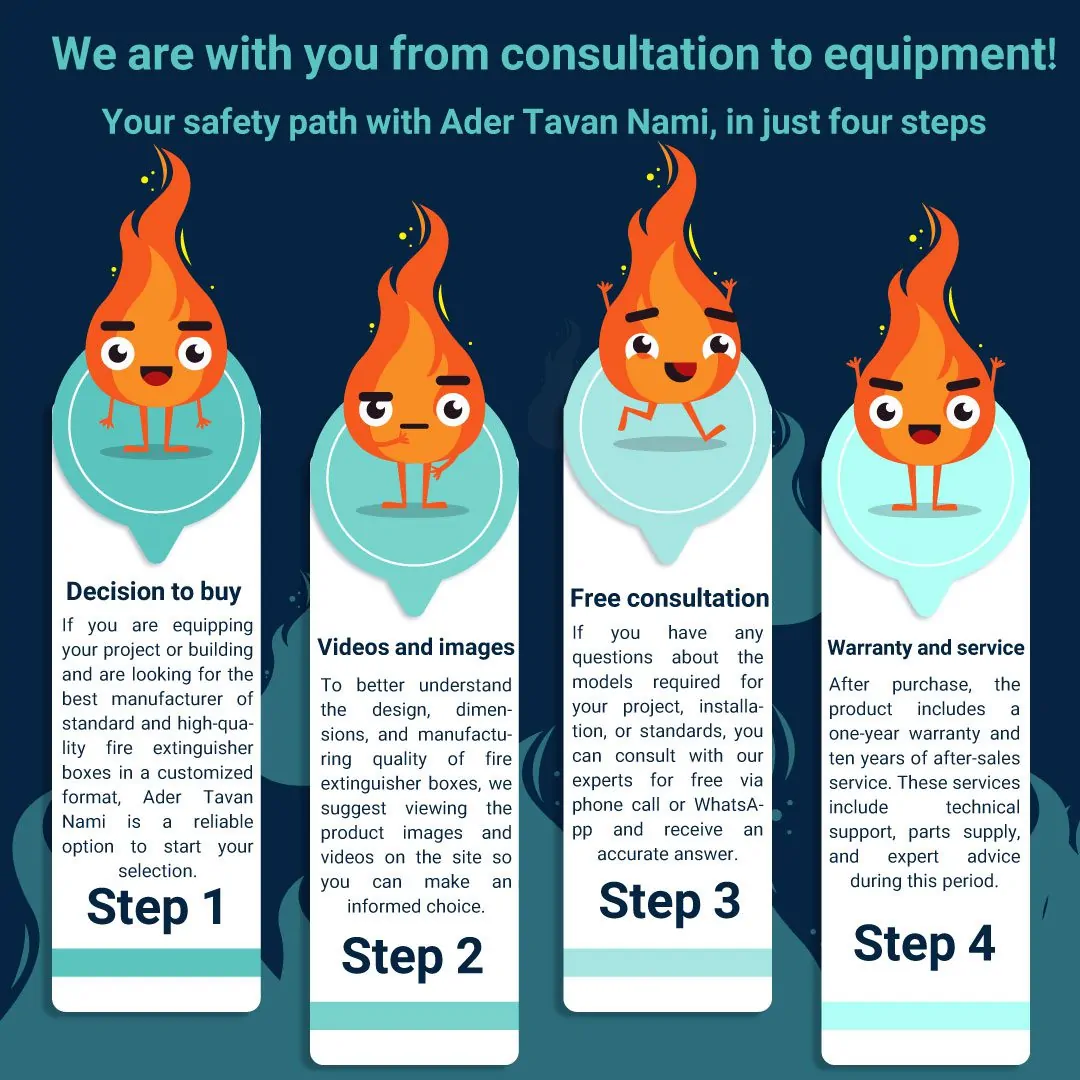
Due to the customizable nature of Ador Tavan Nami products in terms of dimensions, materials, colors, and other specifications, online ordering is not available. However, employers and clients can view and compare products on the Ador Tavan Nami website, and after approval, place their orders by calling the phone numbers listed on the website, using the contact button, or communicating via WhatsApp after receiving free consultation.
Yes, the company’s technical team provides installation, commissioning, and on-site training services for equipment use. These services include performance testing and issuance of confirmation certificates. In high-volume projects, clients can also visit the factory production line and observe the manufacturing process upon prior request.
Yes, since Ador Tavan Nami is a registered vendor on oil and gas refinery vendor lists, our products are certified by the national Fire Department organizations and comply with national and international standards such as ISIRI and NFPA.
Yes, specialized equipment such as fire monitors, foam chambers, foam tanks, and industrial valves are designed and manufactured for oil, gas, and petrochemical projects. Additionally, foam tanks, which are among the main equipment for such projects, are custom-manufactured based on the client’s technical requirements. Product test and inspection videos are available in the video and image gallery section of the website.
Yes, in-person and online training for proper equipment usage, maintenance, and emergency response is provided by company specialists.
Many of the products are designed and manufactured in compliance with NFPA standards. These standards include requirements for the design, installation, and operational performance of safety equipment.
Yes, the company’s engineering team can design customized safety systems, including fire detection and suppression, evacuation routes, and emergency equipment based on project drawings. It is worth noting that Ador Tavan Nami has implemented and executed customized safety designs in numerous urban and national projects to date.
Yes, Ader Tavan Nami has a history of cooperation with governmental organizations, municipalities, ministries, and national infrastructure projects. You can review executed projects in the “Projects” section of the official Ader Tavan Nami website.
Yes, specialized equipment such as sprinklers, smoke detection systems, and emergency showers have been installed in medical centers and hospitals and are compliant with healthcare standards. Some examples include Professor Sami’i Neuroscience Hospital, Atieh Hospital, and Imam Reza Hospital.
Yes, educational, equipment supply, and technical consulting collaborations have been established with fire departments across the country.
Yes, some products have been exported to neighboring countries and the Persian Gulf region and are accompanied by export certificates and international standards.
Yes, OEM services and private-label manufacturing are offered for industrial and commercial clients.
Yes, many products are equipped with QR code labels that allow users to access technical information, warranty details, and user manuals by scanning. In addition, all products have downloadable PDF drawings available in the products section of the website.
Yes, equipment such as fire monitors, nozzles, and metal cabinets are manufactured using materials resistant to high temperatures.
Yes, the company’s products have been used in training and operational drills by fire department organizations, and their performance has been verified. Moreover, many prominent firefighters across the country have tested and evaluated Ader Tavan Nami products and expressed positive feedback, even in comparison with well-known global brands.
Yes, after-sales services including technical support, repairs, spare parts supply, and specialized consulting are provided. All Ader Tavan Nami products are covered by a 10-year after-sales service.
Yes, industrial and organizational clients can visit the factory upon prior coordination and observe the production and quality control processes.
For high-rise buildings, the use of sprinkler systems, fire hose cabinets on each floor, centralized fire alarm systems, fire-resistant elevators, fire-rated doors, and fire-resistant structural elements is recommended. In addition, evacuation routes must be equipped with emergency equipment and must remain unobstructed at all times.
Yes, some equipment is manufactured with anti-corrosion coatings or made of stainless steel and is suitable for humid, coastal, or industrial corrosive environments. Customization in terms of materials, colors, dimensions, and other specifications is available at Ader Tavan Nami.
Yes, outdoor equipment such as fire monitors, waterproof cabinets, and UV-resistant fire extinguishers are specifically designed for open and outdoor spaces.
This includes fire detection and fire suppression systems, fire monitors, foam chambers, foam tanks, industrial fire cabinets, emergency showers, safety eyewash stations, and personal protective equipment (PPE).
In some cases, yes. However, it is strongly recommended that installation be carried out by trained technicians to ensure compliance with safety standards and to maintain the product warranty.
Periodic inspection of system and equipment performance, checking extinguisher pressure, ensuring the integrity of components, cleaning, and documenting service reports are mandatory.
Yes, Ader Tavan Nami can provide a customized safety checklist based on the project type, environment, and identified risks.
Some equipment, such as wall-mounted cabinets and central systems, are designed with reinforced bases to maintain performance under vibration and impact.
Yes, smart fire alarm systems can be connected to mobile applications for remote alerts and monitoring.
Yes, performance testing is possible during exhibitions, drills, or factory visits. Training and test videos are also available on the website. Additionally, for clients ordering large quantities (more than 10 units), sample units can be provided for evaluation upon request.
Yes, upon client request, many products can be integrated with Building Management Systems (BMS) and smart home platforms.
Yes, specialized equipment compliant with ATEX standards is designed for hazardous and explosive environments. Ader Tavan Nami is proud to be the first and sole domestic manufacturer in Iran to produce certain specialized firefighting equipment that was previously available only from foreign suppliers. One such example is the foam system integrated with a foam tank, images of which can be viewed in the product gallery.
Yes, some products feature a high IP protection rating and are suitable for dusty industrial environments. Furthermore, upon client instruction and for harsh operating conditions, the use of more durable materials tailored to the project environment is possible.
Yes, the professional and experienced engineering team at Ader Tavan Nami can design execution drawings, including piping routes, equipment installation locations, and alarm points.
Yes, luxury fire extinguisher cabinets, stainless steel nozzles, and concealed fire alarm systems have been installed in high-end residential and commercial projects. You may review the Luxury Fire Cabinet product in the Fire Cabinet and Products section of the website.
Yes, upon contract agreement, company experts can visit the project site with prior coordination and provide specialized consultation.
Yes, smoke, heat, and gas detection systems can be integrated and synchronized with fire suppression equipment.
Yes, both practical and theoretical training sessions are provided for project personnel covering equipment operation, maintenance, and emergency response. Installation files and technical documents can also be provided upon client request.
Yes, the company’s fire detection equipment can be integrated with smart smoke, heat, and gas sensors and connected to central systems or mobile applications. Ader Tavan Nami’s urban tunnel projects are among those utilizing such systems. These solutions are particularly suitable for large-scale projects or environments such as tunnels, where continuous human monitoring is not feasible.
Yes, in some advanced systems such as centralized fire alarm systems or smart sprinklers, remote monitoring and control via the internet are available.
Yes, specialized equipment such as high-capacity fire monitors, foam systems, and centralized fire alarm systems have been installed in airports.
Yes, company experts can assist in documentation preparation, system design, and coordination with fire department authorities to obtain the required approvals.
Yes, smoke detection systems, sprinklers, and emergency equipment have been installed in metro stations, public transportation terminals, and urban tunnels.
Yes, equipment resistant to heat, explosion, and corrosion has been installed in refineries and petrochemical complexes. Phase 14 of South Pars is one of Ader Tavan Nami’s petrochemical projects, where the fire detection and suppression system was designed and implemented by the company.
Yes, Ader Tavan Nami provides manufacturing, installation, training, and support services throughout the country and has successfully completed projects in many cities nationwide.
Yes, industrial fire detection and suppression systems have been installed in power plants, including thermal, gas, and combined-cycle facilities.
Yes, the company has experience in export and cooperation with international projects and is capable of providing design, manufacturing, and international support services.
Yes, corrosion-resistant and moisture-resistant equipment has been designed and used for ports, piers, vessels, port facilities, and offshore oil platforms.
Yes, Ader Tavan Nami designs and manufactures specialized equipment tailored to project requirements, operational environments, and technical specifications, with the highest level of detail.
Yes, equipment resistant to dust, impact, and high temperatures has been installed in mines and mining industries.
Yes, the engineering team provides services for designing evacuation routes, safety signage, emergency lighting, emergency exit equipment, and fire-rated doors.
Yes, high-sensitivity smoke detection systems, gaseous fire suppression systems, and temperature control equipment have been installed in data centers.
Yes, the company can offer customized product packaging with bespoke design, logo, and corporate colors, especially for export or exhibition projects.
Yes, the company’s products have been showcased and well received at safety, construction, oil and gas, petrochemical, and related exhibitions.
Yes, in special circumstances such as emergency projects or industrial incidents, the company provides rapid supply, installation, and commissioning services.
Yes, the company’s equipment has been used in schools, universities, and safety training centers for safety education and practical drills.
Yes, the company’s safety team can develop and provide safety procedures, operational checklists, and equipment usage guidelines.
Yes, specialized equipment has been installed in high-risk environments such as chemical plants, refineries, petrochemical complexes, power plants, and offshore oil platforms where fire risk is high.
Yes, for export projects, support services, training, and spare parts supply are provided through representatives or international partnerships.
Yes, upon cooperation and order placement, the company can assist in project safety audits, identification of weaknesses, provision of corrective solutions, and preparation of official reports.
Yes, the company provides OEM services and custom manufacturing for international brands, in full compliance with international standards.
Yes, the engineering team designs automatic fire suppression systems using foam, gas, water, or hybrid solutions.
Yes, safety equipment with aesthetically coordinated designs has been used in museums, theaters, and cultural centers.
Yes, upon procurement of equipment and contract execution, the company can assist with documentation, system design, and coordination with relevant authorities to obtain building safety certifications.
Yes, fire detection and suppression systems, fire hose cabinets, and emergency systems have been installed in residential complexes, towers, and housing developments. Please refer to the “Projects” section of the website to view completed projects.
Yes, the company’s safety and graphic design teams provide services for designing warning signs, evacuation route signage, safety symbols, and emergency lighting. It should be noted that in areas with insufficient natural light, signs and symbols can be supplied in photoluminescent, reflective, or illuminated formats upon client request.
Yes, high-temperature-resistant equipment such as metal nozzles, industrial fire monitors, and heat-resistant cabinets has been installed in such projects.
Yes, upon contract execution, the professional technical team at Ader Tavan Nami designs central control panels, sensors, cable routing, and alarm configurations.
Yes, emergency and fire alarm equipment has been installed in urban public spaces such as parks, bus stations, shopping centers, and other public facilities.
A fire extinguisher cabinet is a small, fixed unit designed for initial fire suppression and is essential in buildings, hospitals, and similar facilities, whereas a fire station is an operational center equipped with comprehensive resources and trained personnel.
In advanced projects or in facilities where continuous human supervision is not feasible due to large or unsuitable spaces, connecting fire extinguisher cabinets to the fire alarm system is recommended for better coordination; however, it is not mandatory.
In wet systems, water is constantly present in the pipes, while in dry systems, water is introduced only upon activation. Fire extinguisher cabinets must be compatible with the type of fire suppression system and the environmental conditions of the project.
No, fire extinguisher cabinets and sprinkler systems are independent systems; however, they may share a common water supply source.
Hose reel hoses are more suitable for quick and easy operation, while canvas hoses can withstand higher pressure levels.
Three-way nozzles allow adjustment of the water discharge pattern (straight stream, spray, or shut-off), whereas single-mode nozzles provide only one discharge type.
In cold regions or wet systems, the presence of a drain valve is essential to prevent freezing.
Yes, fire extinguisher cabinets are typically connected to a central pump or booster pump to ensure adequate water pressure for firefighting.
Fiberglass is lightweight and corrosion-resistant, while stainless steel offers higher mechanical strength and is more suitable for industrial environments.
No, cold-rolled steel is vulnerable to moisture and must be protected with anti-corrosion coatings. In humid environments, stainless steel is generally used to prevent rust.
In outdoor and tropical environments, UV-resistant fire extinguisher cabinets prevent discoloration and material brittleness.
Yes, in chemical industries, fire extinguisher cabinets with acid-resistant coatings or PVC bodies are used to prevent corrosion in aggressive environments.
This coating provides high resistance to corrosion, moisture, and impact, while also enhancing the visual appearance.
Yes, tempered glass or impact-resistant plexiglass doors provide safety and allow rapid access. (Printing on plexiglass doors is also available.)
Magnetic locks allow faster opening, while mechanical locks provide greater protection against unauthorized tampering.
Yes, in high-risk environments such as refineries, explosion-proof fire extinguisher cabinets with reinforced bodies and safe fittings are used.
Aluminum is lightweight, corrosion-resistant, and offers good heat resistance, but it is generally more expensive than steel.
Yes, some models are designed with nano-coatings that provide water and dust resistance for specialized environments.
Explosion-proof bodies, spark-resistant nozzles, oil-resistant hoses, and specific certifications are mandatory. It should be noted that Ader Tavan Nami is an approved vendor for the oil and petrochemical industries and therefore manufactures all products in strict compliance with safety requirements.
Yes, fire extinguisher cabinets in tunnels must be equipped with internal lighting, impact-resistant doors, and installed at defined intervals. Monitoring and control of cabinets and equipment can also be managed via internet connectivity or a central control room.
In data centers, fire extinguisher cabinets must be integrated with non-conductive equipment and gas-based fire suppression systems.
Yes, smooth surfaces to prevent contamination buildup, the use of stainless-steel materials, antibacterial coatings, and easy cleaning capability are mandatory hospital requirements.
High water pressure, connection to booster pumps, and installation on every floor are key requirements.
Yes, for visibility in low-light conditions, internal LED lighting or visual warning indicators are recommended.
Acid-resistant bodies, chemically resistant hoses, and specialized nozzles are required
Yes, simple visual guides are essential for quick training and use by students or staff.
Yes, the design, color, and placement should be coordinated with the architectural environment.
Yes, reinforced bodies and impact-resistant doors are recommended to prevent damage in high-activity environments.
Yes, the location, serial number, and operational status of fire extinguisher cabinets must be documented in safety audit reports.
HSE, CMMS, and ERP software systems can be used to register, service, and generate periodic alerts for fire extinguisher cabinets .
Yes, QR codes enable quick access to information such as service history and installation location.
They are registered as safety assets with unique identification codes, installation locations, service status, and performance history.
Yes, the quantity, locations, condition, and corrective actions related to fire extinguisher cabinets must be documented in HSE reports.
They are defined within safety or asset modules with technical specifications, product codes, supplier information, and maintenance schedules.
Yes, serial numbers are mandatory for traceability, warranty validation, and product identification.


